
I-10 / I-15 Breakdown? Inland Empire Freeway Survival Guide
Step 1: Get to Safety
The moment you realize something is wrong with your vehicle on a freeway, your number one priority is getting off the road. Here's what to do:
- Signal and pull to the right shoulder as quickly and safely as possible. The right shoulder is almost always the safest option — avoid the left shoulder (center median) unless there is absolutely no alternative.
- Turn on your hazard lights immediately. This alerts other drivers that you're disabled and helps prevent a secondary collision.
- Stay inside your vehicle if possible. A disabled car on the shoulder of a busy Inland Empire freeway is a dangerous place. Exiting your vehicle puts you at risk from passing traffic, especially at night or during rush hour. Keep your seatbelt on and wait for help.
- If you must exit, do so from the passenger side (away from traffic). Move well beyond the shoulder and stand behind a guardrail or up an embankment if available.
- Set up reflective triangles or flares if you have them and it's safe to do so. Place them 50, 100, and 200 feet behind your vehicle to give approaching drivers warning.
Step 2: Call for Help
Once you're safely positioned, it's time to make calls:
- Call 911 if the situation is dangerous — if your vehicle is partially blocking a lane, if there's been a collision, if you're in an area without a shoulder, or if anyone is injured.
- Call a towing company you trust. Don't wait for a random tow truck to show up — those "roaming" trucks on freeways often charge significantly more. Call Fast Hook Towing at 747-204-8846 for a guaranteed upfront price and fast response.
- Know about the CHP Freeway Service Patrol (FSP). On major Inland Empire freeways during commute hours, CHP runs free FSP trucks that help with minor issues like flat tires, overheating, and dead batteries. They patrol the I-10, I-15, SR-60, and SR-91 during peak hours. However, if your vehicle needs to be towed, you'll still need a tow company.
Major IE Freeways We Cover
Fast Hook Towing LLC provides emergency towing and accident recovery on every major highway in the Inland Empire. Here's a breakdown:
I-10 (San Bernardino Freeway)
Running east-west from San Dimas through Pomona, Ontario, Fontana, and into San Bernardino, the I-10 is one of the busiest corridors in the region. We regularly respond to breakdowns and accidents along this stretch, particularly near the I-10/I-15 interchange in Ontario — one of the most congested interchanges in California.
I-15 (Ontario Freeway / Barstow Freeway)
The I-15 runs north-south from Corona through Rancho Cucamonga, Fontana, and up toward Victorville and the route to Las Vegas. This freeway sees heavy weekend traffic from travelers heading to and from Vegas, and breakdowns are common in the Cajon Pass due to steep grades and extreme heat in summer.
I-210 (Foothill Freeway)
Connecting Pasadena to San Bernardino through Rancho Cucamonga and Upland, the I-210 is a critical east-west connector along the foothills. We cover the entire stretch from Glendora to San Bernardino.
SR-60 (Pomona Freeway)
Running from Diamond Bar through Pomona, Ontario, and into Riverside and Moreno Valley, the SR-60 is a heavily traveled commuter route. Breakdowns during morning and evening rush hour are especially common near the 60/15 interchange.
SR-91 (Riverside Freeway)
Connecting Riverside westward toward Anaheim, the SR-91 is notorious for congestion. Breaking down in heavy traffic on this freeway is stressful — call us immediately and we'll navigate to your location as fast as possible.
I-215
Running from San Bernardino south through Riverside and into Moreno Valley and Murrieta, the I-215 connects the heart of the Inland Empire. We respond to calls along the entire corridor.
Our Response Times by Corridor
When you're stuck on the side of a freeway, every minute feels like an hour. Here's what you can realistically expect from Fast Hook Towing:
- I-10 (Ontario to Fontana): 20–30 minutes
- I-15 (Rancho Cucamonga to Fontana): 20–30 minutes
- I-210 (Upland to San Bernardino): 25–35 minutes
- SR-60 (Pomona to Riverside): 25–35 minutes
- I-15 Cajon Pass: 30–45 minutes depending on location
- SR-91 (Riverside corridor): 25–35 minutes
These are averages. Traffic, time of day, and exact location all factor in. When you call, we give you an honest ETA — not a fake "15 minutes" promise.
What to Expect When Your Tow Truck Arrives
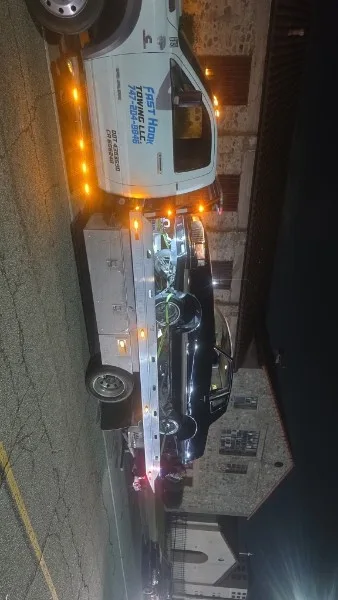
When a Fast Hook Towing flatbed arrives at your freeway breakdown:
1. Our driver will position the truck safely behind your vehicle with emergency lights activated to create a buffer zone from traffic.
2. We'll assess the situation — is the vehicle drivable onto the flatbed, or does it need to be winched? Is there any damage or safety concern?
3. Your vehicle is loaded onto the flatbed using either the drive-on ramp or our winch system. All four wheels come off the ground for maximum protection.
4. We secure the vehicle with wheel straps and safety chains before moving.
5. We transport you and your vehicle to the destination of your choice — your mechanic, home, dealership, or body shop.
We also offer fuel delivery and jump start service if your issue is something simple like running out of gas or a dead battery.
Call Fast Hook Towing — 747-204-8846
Don't wait on the shoulder hoping for help. Call 747-204-8846 now and save the number in your phone for the future. We provide emergency towing 24 hours a day, 7 days a week, across every freeway in the Inland Empire.
Fast, professional, upfront pricing — every time.