
Complete Guide to EV & Tesla Towing — Inland Empire
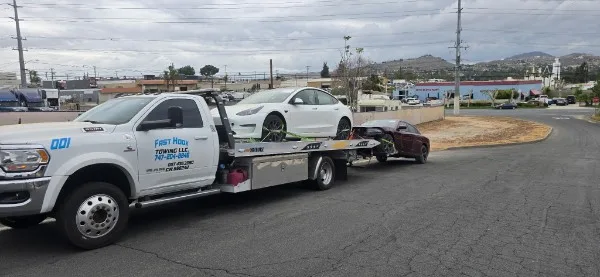
Why You Can't Tow an EV Like a Regular Car
Electric vehicles are fundamentally different from gas-powered cars when it comes to towing, and getting it wrong can cause thousands of dollars in damage. Here's why.
Traditional gasoline vehicles can be towed with two wheels on the ground because you can shift them into neutral, disconnecting the engine from the drivetrain. Electric vehicles don't work that way. When the wheels of an EV spin, they turn the electric motor, which acts as a generator through a process called regenerative braking. Even when the car is "off," dragging an EV with its wheels on the ground forces the motor to generate electricity with nowhere to go. This can overheat the motor, destroy the inverter, and cause catastrophic damage to the battery pack.
Most EVs — including Teslas, Rivians, BMW iX models, and Hyundai Ioniq 5s — have no true neutral gear in the traditional sense. Some offer a "transport mode" or "tow mode," but even these are designed for short distances on a flatbed, not for dragging the vehicle down the highway.
Bottom line: Every electric vehicle should be towed on a flatbed truck. No exceptions.
Tesla Transport Mode: What It Is and How to Activate It
Tesla vehicles include a feature called Transport Mode that disengages the parking brake and allows the car to roll freely so it can be loaded onto a flatbed. Here's how to activate it:
For Tesla Model 3 and Model Y:
1. Put the vehicle in Park
2. Go to Controls > Service > Towing on the touchscreen
3. Tap Transport Mode
4. The car will confirm that Transport Mode is active — the parking brake releases and the vehicle can now roll freely
5. The car must have enough battery charge to power the touchscreen (at least 10-15%)
For Tesla Model S and Model X:
- Older Model S and X vehicles with air suspension may need to be set to Standard or High ride height before loading onto a flatbed
- The process is similar through the touchscreen, but the menu path may differ slightly depending on software version
- If the 12V battery is dead, the frunk can be opened manually to access the emergency cable release for the front tow hook cover
Important: If the Tesla has zero battery and the touchscreen is unresponsive, Transport Mode cannot be activated through the screen. In this case, the tow operator needs to use the car's emergency tow eye (located behind the front bumper cover) and winch the vehicle onto the flatbed without rolling the wheels. This requires specialized knowledge — and it's exactly why you need an EV-qualified towing company.
What Happens If Your EV Battery Dies on the Road
Unlike a gas car that ran out of fuel, you can't just bring a can of electrons to an EV on the side of the road. Here's what actually happens when your EV hits zero:
- You can't jump-start it like a traditional vehicle. The high-voltage battery pack that drives the motor is completely separate from the 12V battery that powers accessories. A jump start only helps the 12V system — it won't move the car.
- The vehicle must be flatbed-towed to the nearest charging station, dealership, or your home charger.
- Some EVs enter a protective shutdown when the battery gets critically low, which can lock out systems including the ability to shift into neutral or activate transport mode.
If your EV dies on the I-10 in Ontario or the I-15 near Fontana, don't try to flag down a random tow truck. Call a company that understands high-voltage systems and carries the right equipment. Fast Hook Towing responds to EV breakdowns across the entire Inland Empire.
How to Choose an EV-Qualified Towing Company
Not every tow truck operator is trained to handle electric vehicles safely. Here's what to look for:
- Flatbed-only service — any company that suggests towing your EV with a wheel-lift or dolly doesn't understand EVs. Walk away.
- High-voltage awareness training — EV battery packs operate at 400-800 volts. Operators should know not to touch exposed wiring or damaged battery components after a collision.
- No dragging, ever — the vehicle should be winched onto the flatbed if it can't roll on its own. Dragging an EV even 20 feet can damage the motor.
- Experience with your specific make — Tesla, Rivian, BMW, and Hyundai all have slightly different tow procedures. A qualified company knows the differences.
Fast Hook Towing LLC has invested in training and equipment specifically for EV and Tesla towing. Our flatbed trucks are equipped to handle all major EV brands safely.
EV Charging Stations in the Inland Empire
If your EV needs to be towed to a charger, it helps to know where the closest options are. The Inland Empire has a growing network of fast-charging stations:
- Ontario — Tesla Superchargers at Ontario Mills and near the Ontario International Airport, plus ChargePoint and EVgo stations along Haven Avenue
- Rancho Cucamonga — Supercharger at Victoria Gardens, multiple Level 2 chargers at shopping centers along Foothill Boulevard
- Riverside — Supercharger near the Riverside Plaza, Electrify America stations along University Avenue
- Fontana — Fast chargers along Sierra Avenue and near the Auto Club Speedway
- San Bernardino — Charging options near Hospitality Lane and the San Bernardino Transit Center
When you call us, we can tow your EV to whichever charging station or dealership is most convenient for you.
Call Fast Hook Towing for EV Service
If you drive a Tesla, Rivian, BMW iX, Hyundai Ioniq, Ford Mustang Mach-E, or any other electric vehicle in the Inland Empire, save our number now. When you need a tow, you need a company that knows how to handle your car without causing damage.
Call 747-204-8846 any time — 24 hours a day, 7 days a week. Learn more about our EV and Tesla towing service or request a quote online.